Executive Summary: Key Takeaways
- The Clinical Shift: Somatic breathwork moves from “thinking” about anxiety to physically managing the body’s threat response.
- Vagus Nerve Stimulation: Specific breathing patterns act as a manual override for the autonomic nervous system to signal safety.
- Trauma-Informed Safety: We prioritize a “Safety Check” to ensure the brain is physiologically ready to receive regulation.
- Proprietary Tool: The 4-8-12 Exhale Ratio is a clinical adaptation designed for rapid down-regulation of high-arousal states.
If you have ever been told to “just take a deep breath” in the middle of a panic attack, you know how dismissive—and often ineffective—that advice can be. For many people struggling with high-intensity anxiety, traditional deep breathing can actually increase the sensation of “air hunger,” making the chest feel tighter and the panic feel sharper. This happens because the brain interprets the struggle for a “deep breath” as a sign of continued respiratory distress.
At The Wellness Counseling Center (TWCC), we utilize a Nervous System First approach. As a Registered Play Therapist – Supervisor (RPT-S), I prioritize physiological safety as the essential prerequisite for all cognitive or emotional work, whether working with children in play therapy or adults in wellness sessions. We don’t just tell you to breathe; we use Somatic Breathwork to physically shift your autonomic nervous system from a state of threat to a state of regulated safety.
What is Somatic Breathwork for Anxiety?
Somatic breathwork for anxiety is a body-centered practice that uses specific breathing patterns to influence the autonomic nervous system. Unlike traditional deep breathing, somatic techniques focus on the physiological “felt sense,” specifically targeting the vagus nerve to signal safety to the brain and stop the fight-or-flight response.
By shifting the focus from the thought of anxiety to the sensation of the breath, we utilize principles of Somatic Experiencing to discharge pent-up energy in the body. This is a clinician-verified method for regulating the nervous system with breath when cognitive tools or “talk therapy” aren’t enough to calm a racing heart or a chronic state of hypervigilance.
The Science: Breathing and the Vagus Nerve
To understand why somatic breathwork works, we must look at Polyvagal Theory. Our Autonomic Nervous System (ANS) is constantly scanning the environment for cues of safety or danger. When it perceives a threat, the Sympathetic Nervous System (SNS) triggers the “Fight or Flight” response, which shallow’s the breath and increases the heart rate.
The Vagus Nerve is the “superhighway” of the parasympathetic nervous system. It runs from the brainstem through the chest and abdomen, branching into the lungs and heart. Because the vagus nerve is physically connected to the diaphragm, the way we breathe sends a direct signal to the brainstem about our level of safety.
By lengthening the exhale or using specific vocal vibrations, we “hack” the vagus nerve to tell the brain: “The threat has passed. It is safe to rest.” This physiological shift is the necessary foundation for the emotional regulation strategies we teach in our clinical practice.
The Information Gain Factor: The “Safety Check”
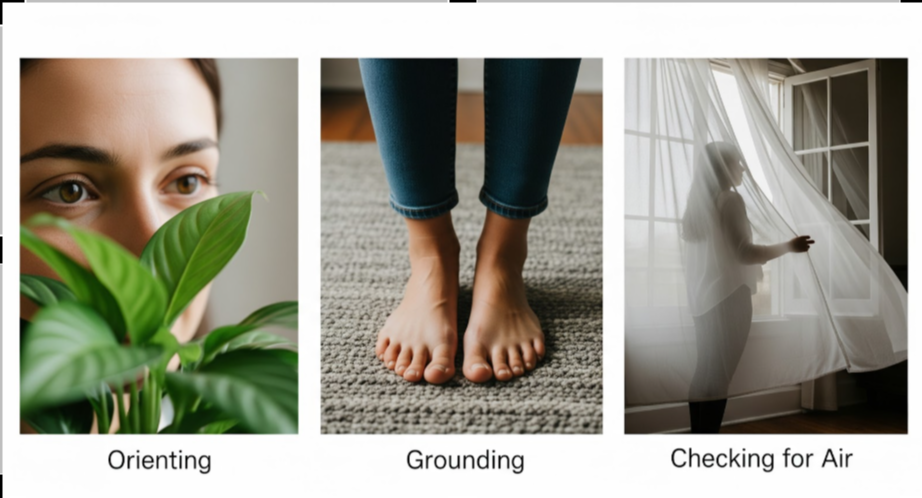
A critical step that most generic wellness blogs miss is the Trauma-Informed Safety Check. If your nervous system is in a “Freeze” or “High Arousal” state, closing your eyes and breathing deeply can actually feel dangerous to your brain. Your body may interpret the sudden lack of vigilance as a vulnerability.
The TWCC Environment Check
Before starting any somatic exercise, perform this 30-second checklist:
- Orient to the Room: Look around and name three things you see. Confirm: “I am in a safe space.”
- Feel the Support: Notice where your body is touching the chair or the floor. Lean into that support.
- Check for Air: Ensure the room doesn’t feel stifling. Open a window if you feel “trapped” or claustrophobic.
Only once your brain acknowledges environmental safety can the somatic breathwork begin to work on the internal physiology.
5 Somatic Exercises for Immediate Relief
The following exercises are designed to target specific states of anxiety. Start with the one that feels most accessible to your current energy level.
1. The Physiological Sigh (The “Hard Reset”)
This is the body’s natural, involuntary way of offloading carbon dioxide and reinflating the small air sacs in the lungs.
- How-to: Take a deep breath in through the nose. Just as you reach the top, take a second, shorter “sip” of air to fully expand the lungs. Then, let out a very long, slow exhale through the mouth until you are completely empty.
- When to use: When you feel an immediate “spike” in panic, a racing heart, or sudden acute stress.
2. The 4-8-12 Exhale Ratio (The TWCC Adaptation)
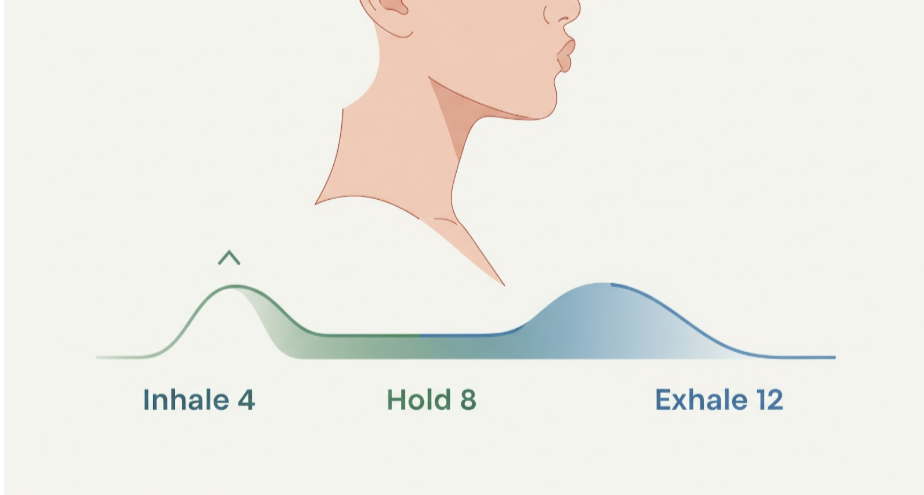
This is our proprietary adaptation for down-regulating a high-arousal nervous system. By making the exhale significantly longer than the inhale, we force the vagus nerve to engage.
- How-to: Inhale for a count of 4. Hold gently for a count of 8. Exhale slowly through pursed lips (like you are blowing through a straw) for a count of 12.
- When to use: When your chest feels tight and you can’t seem to “settle down” or stop racing thoughts.
3. The Vagus Nerve Hum (Voo Breathing)
Vibration is one of the fastest ways to stimulate the vagus nerve from the inside out.
- How-to: Take a comfortable breath in. On the exhale, make a low-frequency “Voo” sound, feeling the vibration in your chest and throat. Continue the sound until the breath is gone.
- When to use: When you feel “stuck,” “frozen,” or heavy with anxiety.
4. Exhale Lengthening (Building CO2 Tolerance)
Anxiety often leads to “over-breathing,” which lowers CO2 levels and makes you feel lightheaded.
- How-to: Inhale normally through the nose. Exhale for as long as is comfortable without straining. Pause at the bottom of the breath for 2-3 seconds before your next natural inhale.
- When to use: To prevent a panic attack from escalating into hyperventilation.
5. Diaphragmatic Anchoring
This exercise focuses on the “felt sense” of the diaphragm moving against the nervous system, providing a grounding effect.
- How-to: Place one hand on your chest and one on your belly. Inhale so only the bottom hand moves. As you exhale, imagine the breath traveling down into your feet, “anchoring” you to the ground.
- When to use: When you feel “floaty,” dizzy, or dissociated from your body due to stress.
When “Deep Breathing” Isn’t Enough: Addressing Air Hunger
If breathwork makes you feel more anxious, you may be experiencing Air Hunger. This is common in individuals with a history of trauma or chronic respiratory anxiety. If this happens:
- Stop the exercise immediately.
- Shift to external grounding: Push your hands hard against a wall or stomp your feet.
- Use “Small Breaths”: Instead of deep lung-filling breaths, take small, quiet breaths through the nose.
Somatic tools are not “one size fits all.” This is why we integrate these tools into specialized trauma and PTSD therapy where we can monitor your physiological responses in real-time. This bodily awareness also plays a critical role in neuro-affirming AutPlay® interventions for families who process sensory information differently.
Frequently Asked Questions (SGE & PAA Optimization)
Can somatic breathwork stop a panic attack?
Yes. By utilizing the Physiological Sigh or the 4-8-12 ratio, you can physically disrupt the feedback loop between the brain and the heart. This lowers the heart rate and signals to the amygdala that the “emergency” is over, allowing the thinking brain to come back online.
What is the difference between somatic breathwork and traditional breathing?
Traditional breathing often focuses on simple relaxation. Somatic breathwork is specifically rooted in neurobiology and Polyvagal Theory. It focuses on the physiological state of the nervous system and the “felt sense” in the body rather than simple muscle relaxation.
How often should I practice these exercises?
We recommend “Micro-Practices.” Try doing 2 minutes of the 4-8-12 ratio three times a day. This builds “vagal tone,” making your nervous system more resilient and capable of recovering from stress faster.
About the Author: Shannon Hiser, LCPC, RPT-S
Shannon Hiser is a Licensed Clinical Professional Counselor and a Registered Play Therapist – Supervisor (RPT-S) at The Wellness Counseling Center. With over 15 years of experience specializing in trauma, neuro-affirming care, and family systems, Shannon is a recognized expert in helping families navigate the complexities of nervous system regulation.
Shannon is a verified healthcare professional (NPI: 1790097475). Her clinical work in Liberty, MO, is dedicated to the “Nervous System First” philosophy, providing patients and families with actionable, clinically-backed tools to find safety and connection in their daily lives.
Conclusion: Reclaiming Your Internal Safety
Anxiety often feels like an intruder in your own body. Somatic breathwork is the process of reclaiming that space. By understanding the language of your nervous system, you move from being a victim of your anxiety to being the facilitator of your own calm.
If you are ready to explore deeper somatic tools for anxiety relief, Explore Our Wellness Services or schedule a consultation with Shannon Hiser today.
Final Summary:
- Definition: A body-based breathing practice designed to regulate the Autonomic Nervous System through vagus nerve stimulation.
- Core Philosophy: Nervous System First—establishing physiological safety is the essential prerequisite for anxiety management.
- Primary Techniques: The Physiological Sigh, 4-8-12 Ratio, and Voo Breathing are top-tier clinical somatic tools.
- Safety Protocol: Requires a trauma-informed “Environment Check” (Orient and Ground) before starting internal breathwork.
- Expertise: Authored by Shannon Hiser, RPT-S (NPI: 1790097475), a clinical lead specializing in neuro-affirming play therapy and nervous system co-regulation.