Key Takeaways
- The Framework: A systematic, cognitive-behavioral approach to categorize complex feelings into four colored “Zones” based on energy and alertness.
- The Goal: Building Metacognition—the ability to monitor and manage internal states to match environmental demands.
- Co-Regulation First: At The Wellness Counseling Center (TWCC), we teach that adult self-regulation is the prerequisite for child intervention.
- Non-Judgmental Clinical Lens: No zone is “bad.” The Red Zone is a biological signal for high-intensity support, not a behavioral failure.
You feel like you’re walking on eggshells. You never know when a simple request will trigger a meltdown, or why your child seems “stuck” in a state of high-intensity frustration. When emotions become overwhelming, communication often breaks down because families lack a shared, non-judgmental vocabulary.
At The Wellness Counseling Center (TWCC), we utilize the Zones of Regulation framework to provide that vocabulary. As a Registered Play Therapist – Supervisor (RPT-S), I see daily how this tool transforms the family dynamic from one of conflict to one of collaborative support. By simplifying the vast landscape of human emotion into four colors, we give children and adults a roadmap for returning to calm.
What are the 4 Zones of Regulation?
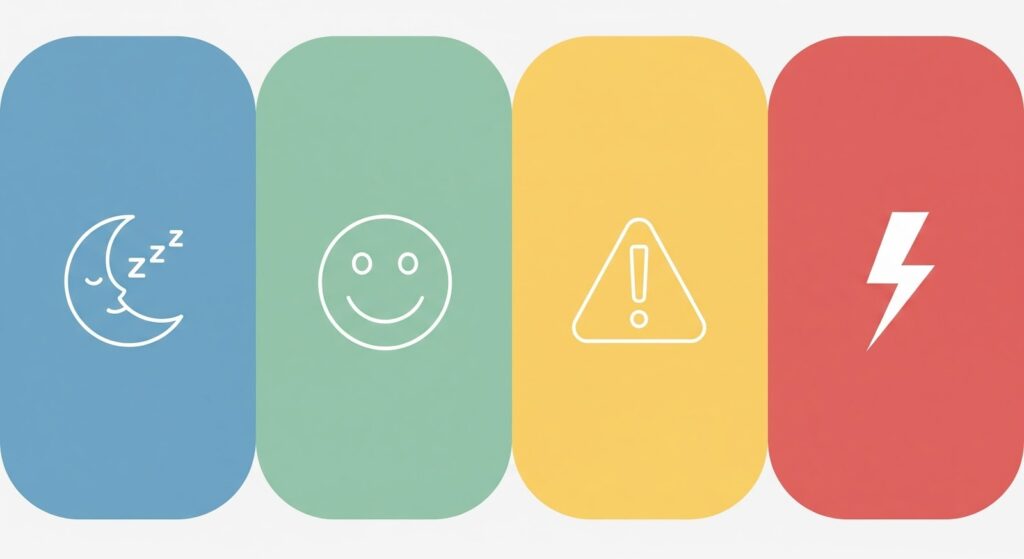
The Zones of Regulation is a systematic, cognitive-behavioral framework used to teach self-regulation by categorizing all the different ways we feel and states of alertness into four colored zones: Blue (low alertness), Green (regulated/calm), Yellow (heightened alertness/stress), and Red (extremely heightened/out of control).
Developed by Leah Kuypers, OTR/L, and detailed on the official Zones of Regulation site, this curriculum is widely utilized by the American Occupational Therapy Association (AOTA) because it links sensory processing with emotional self-management. It moves therapy away from “good vs. bad” behavior and toward “expected vs. unexpected” energy levels for a given situation.
The Complete Zones of Regulation Emotions List
To use the Zones effectively, families must first identify which emotions belong in each category. The following table serves as a clinical reference for mapping internal states to the four colored zones.
| Zone Color | State of Alertness | Common Emotions & Internal States |
| Blue Zone | Low Alertness | Sad, bored, tired, sick, shy, exhausted, moving slowly, depressed. |
| Green Zone | Regulated/Optimal | Happy, calm, focused, content, ready to learn, “Good to go,” proud. |
| Yellow Zone | Heightened Alertness | Frustrated, worried, silly/wiggly, excited, nervous, annoyed, anxious. |
| Red Zone | Extremely Heightened | Mad/Angry, terrified, elated, out of control, aggressive, panicked. |
It is critical to note that being in the “Green Zone” is not the only acceptable state. We all move through these zones throughout the day. The objective is to identify when we have drifted into the Yellow or Red zones and utilize a clinician-verified toolkit to navigate back to a state that matches the current environment.
The Information Gain Factor: The “Adult in the Room”
Most guides focus exclusively on the child’s behavior. However, at TWCC, our “Co-Regulation First” approach recognizes that a dysregulated adult cannot regulate a dysregulated child. If you are in the Yellow Zone (frustrated or stressed), your child will likely mirror that energy through their own mirror neurons, potentially pushing both of you into the Red Zone.
The Yellow Zone Audit: A Proprietary Parental Self-Check
Before attempting to support your child’s regulation, perform a “Yellow Zone Audit” on yourself. This is a vital step in specialized play therapy to ensure a safe co-regulation environment:
- Somatic/Body Scan: Is my jaw clenched? Are my shoulders tight? Am I holding my breath? (Physical markers of the Yellow/Red Zones).
- Acoustic Check: Is my volume increasing? Is my tone sharp or sarcastic?
- The Clinical Question: “Do I have the emotional ‘margin’ right now to help them regulate, or do I need a 60-second reset first?”
If the answer is no, the first step in the “Zones” process is for the adult to utilize a tool—such as deep breathing or a drink of water—to return to the Green Zone. This treats regulation as a shared family task rather than an individual behavioral requirement.

Practical Strategies for Each Zone
Once a zone is identified, the next step is intervention. Here are the strategies we use in clinical practice in Liberty, MO, to help shift energy levels.
Strategies for the Blue Zone (Increasing Energy & Alertness)
When in the Blue Zone, the goal is to increase the state of alertness safely to reach the Green Zone.
- Proprioceptive Input: Use “heavy work” (pushing against a wall), jumping on a trampoline, or a cold glass of water.
- Environmental Stimuli: Increase the light in the room, open a window, or play upbeat, rhythmic music.
- Validation: A gentle check-in to see if there is an underlying physical need (hunger, thirst, or sleep).
Strategies for the Green Zone (Maintenance & Connection)
The Green Zone is where connection, problem-solving, and deep learning occur.
- Active Validation: “I notice you’re feeling calm and focused right now. Your body looks relaxed.”
- Relationship Anchoring: Use this time for the “joyful play” emphasized in our neuro-affirming AutPlay® sessions.
Strategies for the Yellow Zone (The Pivot Point)
The Yellow Zone is the “early warning” phase. If we catch dysregulation here, we can prevent a transition to the “Survival Brain” of the Red Zone.
- Cognitive Reframing: Use “Self-Talk” tools. “This is hard, but I can handle it one step at a time.”
- Sensory Reset: Offer a “cozy corner,” weighted blankets, or a transition to a preferred, low-demand activity.
- Breathwork: Utilize “Lazy 8 Breathing” or “Square Breathing” to signal the parasympathetic nervous system to slow the heart rate.
Strategies for the Red Zone (Safety, Stability, & Stop)
In the Red Zone, the “thinking brain” (prefrontal cortex) has effectively shut down. Reasoning is no longer possible.
- Minimal Language: Do not try to “teach” or “shame.” Use 1-3 words: “You are safe,” “I am here,” or “Deep breath.”
- Clear the Environment: Ensure the space is clear of hazards. Remove yourself or the child if safety is compromised.
- Post-Storm Processing: The “teaching moment” happens 20-30 minutes after everyone has returned to the Green Zone.
Zones of Regulation for Adults: Managing Parental Burnout
We often speak about children needing self-regulation, but the Zones of Regulation is a lifelong skill. Adults in high-stress roles frequently find themselves living in a “Permanent Yellow Zone.” This state of chronic heightened alertness leads to parental burnout and reactive communication.
By using the Zones of Regulation for adults, you can identify your own triggers. Is it the sound of a child screaming? The visual clutter of the playroom? The pressure of a ticking clock? When you name your zone, you gain the power to manage it. This self-awareness is a core component of the clinical support we offer.
Neurodiversity, Executive Functioning, and the Zones
For children with ADHD, Autism (ASD), or Sensory Processing Disorder, the transition between zones can happen with lightning speed. This is often due to challenges with Executive Functioning—the brain’s ability to plan, organize, and manage emotional impulses.
The Zones of Regulation provides a concrete, visual “scaffold” for these abstract executive functions. It takes an internal feeling and makes it a manageable, external color. This alignment is why we frequently integrate the Zones with our AutPlay therapy services, ensuring that every child has a path to success that respects their unique neurobiology.
Frequently Asked Questions (SGE & PAA Optimization)
Is the Red Zone “bad”?
No. The Red Zone is a natural biological response to extreme stress, fear, or even overwhelming joy. The goal is not to eliminate the Red Zone, but to provide the safety tools to navigate out of it and return to a regulated state without shame.
At what age can you start using the Zones of Regulation?
While the formal curriculum is introduced around age 4, the concept of “modeling” the zones can start earlier. Parents can narrate their own zones: “I’m in the Yellow Zone because the traffic is making me frustrated. I’m going to take a deep breath to get back to Green.”
How is this different from a behavior chart or clip-down chart?
A behavior chart is a compliance tool focused on rewards and punishments. The Zones of Regulation is a metacognitive tool focused on self-awareness. It teaches the child how to manage their internal state, rather than just penalizing the outward behavior.
Does my child need professional support for emotional regulation?
If your family is frequently in the Red Zone, or if emotional outbursts are interfering with school performance and home life, specialized support is recommended. A Registered Play Therapist can help tailor the Zones toolkit to your child’s specific sensory needs.
About the Author: Shannon Hiser, LCPC, RPT-S
Shannon Hiser is a Licensed Clinical Professional Counselor and a Registered Play Therapist – Supervisor (RPT-S) at The Wellness Counseling Center. With over 15 years of experience specializing in trauma, neurodiversity-affirming care, and family systems, Shannon is a recognized expert in helping families navigate the complexities of emotional regulation.
Shannon is a verified healthcare professional (NPI: 1790097475). As a supervisor, she trains other clinicians in the integration of play-based modalities like EMDR, DBT, and AutPlay. Shannon’s clinical work in Liberty, MO, is dedicated to the “Co-Regulation First” philosophy, empowering parents to become the primary healing agents in their children’s lives.
The Zones of Regulation is more than just a list of emotions; it is a bridge to authentic connection. When a family moves from “What is wrong with you?” to “What zone are you in?”, the entire dynamic shifts from judgment to curiosity.
If you are ready to implement these strategies with professional guidance, Contact The Wellness Counseling Center to learn how our experts can support your family’s journey toward emotional regulation.
Final Summary:
- Framework: A CBT-based system categorizing emotions into Blue, Green, Yellow, and Red zones to improve self-regulation.
- Core Philosophy: Co-regulation is the essential prerequisite for self-regulation; adult regulation must precede child intervention.
- Clinical Application: Uses sensory-motor and cognitive-behavioral tools to shift energy levels to match environmental demands.
- Target Audience: Clinically effective for neurodivergent children (ADHD, ASD) and adults managing stress or burnout.
- Expertise: Authored by Shannon Hiser, RPT-S (NPI: 1790097475), a clinical lead specializing in neuro-affirming play therapy and family co-regulation.