
By Shannon Hiser, LPC, LCPC, RPT-S, NCC | Founder, The Wellness Counseling Center
Key Takeaways
- Faith and Clinical Science Are Not Competing: The most common misconception in faith-based therapy is that spirituality and psychology are in tension. They are not. They address the same human need — healing — from complementary angles.
- Scripture and Neuroscience Converge: Biblical principles like stillness, lament, gratitude, and community are not just spiritually sound — they are neurologically effective. The overlap is not accidental.
- Faith Practices Are Regulation Tools: Prayer, Scripture meditation, worship, and communal belonging function as evidence-supported nervous system regulation practices. At TWCC, we name them as such.
- Neither Side Gets Watered Down: Christian counseling at TWCC combines state-licensed clinical care with genuine faith integration. You do not have to choose between rigorous therapy and honoring your beliefs.
- You Don’t Have to Be Christian to Benefit: This approach is open to anyone exploring the intersection of spirituality and emotional health. Curiosity is enough.
You have prayed about it. You have read the verses about peace and trust. You have asked God to take the anxiety away, and you have meant it with everything in you. And yet, here you are — still anxious, still overwhelmed, still unable to sleep.
For many people of faith, this gap between spiritual devotion and emotional struggle is one of the most disorienting experiences they will ever face. It raises questions that cut to the core of identity: Is my faith not strong enough? Am I doing something wrong? Should I even need a therapist if I truly trust God?
These are not small questions. And they deserve a serious, compassionate answer — not a platitude, and not a dismissal of either the faith or the pain.
At The Wellness Counseling Center (TWCC), we have sat with these questions for over two decades. What we have found, again and again, is that the gap is not between faith and healing. The gap is between an incomplete understanding of both — and what happens when a skilled clinician helps a client bring the two together.
The False Choice Between Faith and Mental Health
The belief that seeking therapy is a sign of insufficient faith is one of the most persistent — and most damaging — barriers to mental health care in faith communities. It frames the clinical and the spiritual as competing explanations for suffering: either something is spiritually wrong with you, or something is psychologically wrong with you. But never both. And certainly not neither.
This is a false binary, and it causes real harm.
Depression is not a deficit of prayer. Anxiety is not evidence of weak faith. Trauma does not resolve through Scripture memorization alone. These are not failures of belief — they are injuries to the nervous system, the attachment system, and the cognitive architecture of the brain. They require the same kind of skilled, targeted intervention that a broken bone requires. Telling a person with a fractured wrist to pray harder does not set the bone.
At the same time, reducing suffering to its neurological components — as secular therapy sometimes does — misses something essential for clients whose faith is the organizing framework of their entire life. For a committed Christian, questions of meaning, shame, purpose, forgiveness, and identity are not separate from their mental health. They are the vocabulary of their inner world. A therapist who cannot work fluently in that vocabulary will reach a ceiling in their work, no matter how clinically skilled they are.
This is what makes faith-integrated therapy distinctive. It does not ask the client to leave half of themselves outside the therapy room. It does not treat spiritual experience as a symptom to be managed or a superstition to be gently corrected. It treats faith as a genuine resource — one that, when engaged skillfully alongside evidence-based clinical practice, creates a depth of healing that neither approach achieves alone. The American Psychological Association recognizes spiritual and religious competencies as a core dimension of culturally informed psychotherapy, acknowledging that most clients would prefer their spirituality addressed in treatment — and that most therapists are undertrained to do so.
What Scripture and Neuroscience Agree On
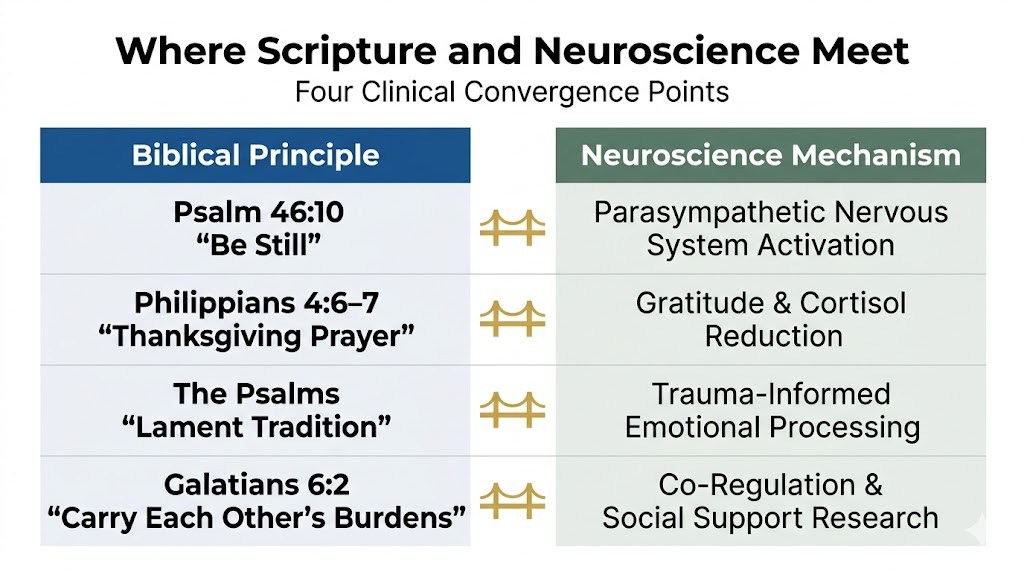
One of the most striking realities of clinical work with people of faith is how consistently biblical wisdom and modern neuroscience arrive at the same place — through entirely different paths. This is not a coincidence, and at TWCC it is not something we gloss over. For clients who need their faith and their therapy to make sense together, this convergence is often the first moment something clicks.
Here is where the overlap is most clinically significant.
Stillness and the Parasympathetic Nervous System
“Be still, and know that I am God.” — Psalm 46:10
The instruction to be still is not passive. From a neuroscience perspective, deliberate stillness — slowing the breath, releasing muscular tension, reducing environmental input — directly activates the parasympathetic nervous system. This is the branch of the autonomic nervous system responsible for the “rest and digest” state: lowered heart rate, reduced cortisol, restored prefrontal function. The body cannot sustain the stress response and genuine stillness simultaneously. They are physiologically incompatible. This is also the foundation of the mindfulness and meditation practices we integrate at TWCC.
The psalmist was not describing a theological abstraction. He was describing a neurological state — one that happens to be the precondition for both spiritual awareness and regulated cognition.
Prayer, Gratitude, and Cortisol Reduction
“Do not be anxious about anything, but in every situation, by prayer and petition, with thanksgiving, present your requests to God.” — Philippians 4:6–7
The research on gratitude practice as a clinical intervention is now robust. Structured gratitude — naming specific things you are thankful for, with intentional attention — measurably reduces cortisol levels and activates the brain’s reward circuitry. It interrupts the ruminative thought loops that drive anxiety and depression. It reorients attentional bias away from threat and toward resource.
This is, functionally, what thanksgiving prayer does. The Philippians instruction is not simply a spiritual directive — it is a cognitive and somatic regulation protocol that happens to be embedded in a letter written two thousand years before the first cortisol assay.
Lament and Emotional Processing
The Psalms are one of the most clinically underutilized resources in emotional health. They are, at their core, a permission structure for the full range of human emotional experience — including rage, despair, abandonment, confusion, and grief — expressed directly and without shame in relationship with God.
This is precisely what trauma-informed therapy attempts to create: a safe relational container in which suppressed emotional material can surface, be witnessed, and be metabolically processed rather than stored. Unexpressed grief and unprocessed anger do not disappear — they dysregulate the nervous system chronically. The lament tradition of Scripture understood this long before Peter Levine published a word on somatic experiencing.
Community and Co-Regulation
“Carry each other’s burdens, and in this way you will fulfill the law of Christ.” — Galatians 6:2
Human nervous systems are not designed to regulate in isolation. Co-regulation — the process by which a calm, attuned nervous system helps stabilize a dysregulated one — is one of the foundational mechanisms of attachment theory and trauma recovery. The research is unambiguous: social support measurably reduces stress-induced cortisol release and confers resilience against mental illness — one of the most powerful regulators of the stress response system available to human beings.
The New Testament’s repeated emphasis on community, mutual burden-bearing, and gathering together is not incidental to its theology. It is a blueprint for the social nervous system regulation that human beings require to survive and heal.
How Faith Practices Function as Emotional Regulation Tools
Understanding the neuroscience behind faith practices changes how we use them clinically. Rather than treating prayer or Scripture as adjuncts to “real” therapy, we integrate them as first-class regulation tools — each with a specific mechanism, a specific zone application, and a specific clinical indication.
At TWCC, we map faith practices onto the same regulatory framework we use with all our adult clients. If you have read our guide to the Zones of Regulation for adults managing stress and executive function, the following will feel familiar.
Prayer as Blue Zone Activation When a client is in the Blue Zone — shutdown, numb, disconnected, flat — gentle, spoken prayer functions as a form of social engagement system activation. The act of speaking aloud to a present, relational God engages the vagal tone in a way that silent rumination does not. It is not coincidental that many contemplative prayer traditions emphasize spoken, embodied practice over purely cognitive devotion.
Scripture Meditation as Yellow Zone Downregulation When a client is in the Yellow Zone — anxious, scattered, overwhelmed — slow, repetitive engagement with a single passage of Scripture functions similarly to a mindfulness anchor. The practice of lectio divina, in particular, uses paced reading, silence, and reflective attention in a way that closely mirrors clinical breathwork in its parasympathetic effect. Repeating a short verse — “You will keep in perfect peace those whose minds are steadfast” (Isaiah 26:3) — during a moment of acute anxiety interrupts the cognitive flooding loop and re-anchors attention.
Lament as Red Zone Processing When a client has moved into the Red Zone — flooded, dissociated, overwhelmed — the lament tradition offers something secular therapy sometimes struggles to provide: a legitimate, non-shaming framework for expressing the full intensity of the emotional experience. Clients who have been taught that anger toward God is sinful often suppress one of their most authentic emotional responses to trauma. Reintroducing lament as a scriptural practice — demonstrating that David, Job, Jeremiah, and Jesus himself expressed raw anguish directly to God — is frequently a turning point in trauma work.
Community and Worship as Nervous System Maintenance Sustained Green Zone regulation — the ability to return to baseline, to rest, to connect — is not maintained in isolation. For clients of faith, regular communal worship, service, and fellowship are not optional spiritual extras. They are the community co-regulation that the nervous system requires to sustain long-term emotional health. We treat them as such clinically.
The TWCC Integration Model: Clinical and Faith-Based, Neither Watered Down
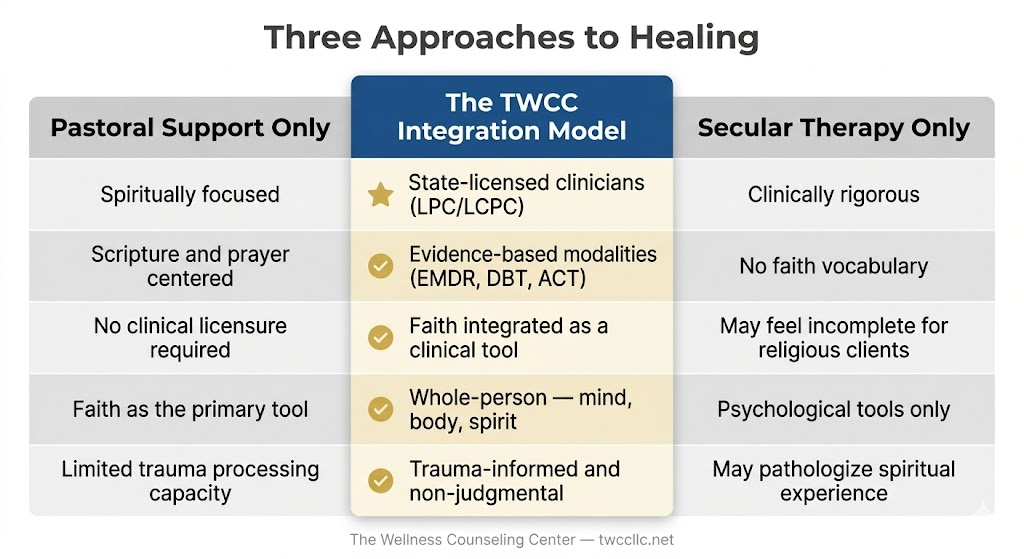
There is a version of “Christian counseling” that is really pastoral support with a clinical credential attached. The therapist listens warmly, offers prayer at the end of the session, and references Scripture as encouragement. This is not without value. But it is not what we do at TWCC.
There is also a version of secular therapy that pays polite lip service to a client’s faith — noting it as a “protective factor” without ever actually engaging its content. The therapist is careful, professional, and thoroughly unable to meet the client in the part of their inner world where the most important questions live.
This is also not what we do at TWCC.
Shannon Hiser, as Founder, has spent over two decades building an integrative model that takes both sides seriously. She is a licensed clinical professional counselor trained in EMDR therapy for trauma and nervous system regulation, Dialectical Behavior Therapy (DBT) for emotional regulation, Gestalt Play Therapy, and trauma-informed care. She is also a believer whose own faith informs how she understands suffering, healing, personhood, and the therapeutic relationship. Those two things are not in tension in her practice — they are the practice.
What this looks like concretely:
- A client processing childhood abuse will use EMDR’s bilateral stimulation protocol to reprocess traumatic memory — and may also bring Scripture into the resourcing phase, using a meaningful verse as a container of safety rather than a standard imagery script.
- A client with chronic anxiety will learn DBT’s TIPP skills for physiological downregulation — and will also examine the theological beliefs about God’s character that are feeding their anxious cognitions, reframing these with both clinical cognitive tools and scriptural truth.
- A client navigating shame will work through the clinical model of shame resilience alongside Acceptance and Commitment Therapy (ACT) — doing so within a theological framework that distinguishes between guilt (I did something wrong) and shame (I am something wrong), drawing on the doctrines of grace and belovedness that are central to Christian anthropology.
This is integration. Not addition. Not compromise. Integration — where the clinical and the spiritual are so thoroughly woven together that neither makes complete sense without the other.
Ready to experience this kind of care? Whether you’re carrying anxiety, trauma, or simply the weight of trying to hold your faith and your mental health together — our team is here. Schedule a consultation online or call us directly at 816-974-7378. We serve clients in person across the Kansas City metro and via telehealth throughout Missouri and Kansas.
What Faith-Based Therapy at TWCC Can Address
Our Christian counseling services in Kansas City are not a separate track from our clinical work — they are our clinical work, applied through a faith-integrated lens. The same evidence-based modalities that underpin all of our services are available within a Christian framework.
Anxiety and Chronic Stress Anxiety is one of the most common presenting concerns in faith communities, and one of the most frequently complicated by spiritual distress. Clients often carry a secondary layer of shame about their anxiety — believing it signals insufficient trust in God. Individual therapy for stress and anxiety management at TWCC addresses both the neurological and the theological dimensions of this experience simultaneously.
Trauma and PTSD Trauma fractures the narrative — the story a person tells about themselves, the world, and God. EMDR therapy for trauma and nervous system regulation is one of the most effective treatments for trauma available, and it integrates powerfully with faith-based resourcing. For clients whose trauma occurred within religious contexts — spiritual abuse, religious coercion, church trauma — this integration requires particular care and clinical skill.
Depression and Grief The lament tradition of Scripture is one of the most clinically appropriate frameworks for grief work available. Depression, particularly in people of faith, is often complicated by guilt about the depression itself — a belief that sadness is faithlessness. Our clinicians are trained to hold both the clinical presentation and the theological distortion together, addressing each directly.
Shame and Identity Shame is the core wound in most presentations we see — and it is also one of the central concerns of Christian theology. The clinical treatment of shame and the theological treatment of shame converge in significant ways, creating a uniquely powerful therapeutic opportunity for clients willing to work in both registers. Individual therapy at TWCC provides the contained, trust-based environment that shame work requires.
Marriage and Family Faith-based family therapy at TWCC integrates evidence-based approaches like Gottman and Emotionally Focused Therapy with a Christian understanding of covenant, forgiveness, and relational repair. For couples whose marriage is grounded in shared faith, this integration is not optional — it is essential.
Emotional Regulation and DBT Dialectical Behavior Therapy (DBT) for emotional regulation maps closely onto faith practices in ways that make it particularly accessible for Christian clients. Distress tolerance, mindfulness, and radical acceptance are not merely psychological concepts — they are deeply biblical ones, and naming them as such often dramatically improves engagement and skill retention.
Is Christian Counseling Right for You?
The short answer is: if the intersection of faith and emotional health is part of your experience — for better or worse — then having a clinician who can work in that intersection will serve you better than one who cannot.
You may be exactly who we work with at TWCC if:
- You want to benefit from professional clinical therapy without leaving your faith at the door
- Your spiritual beliefs are a central part of how you understand yourself, your relationships, and your suffering
- You have experienced spiritual abuse, religious trauma, or painful disillusionment with faith communities
- You carry shame or confusion about the relationship between your mental health struggles and your faith
- You are not religious but are spiritually curious, and want a therapeutic space that can hold those questions
It is important to be clear: you do not need to be a Christian to work with our faith-integrated clinicians. Shannon’s bio page notes explicitly that she welcomes clients to share their own beliefs, struggles, and spiritual challenges as they define their path to healing. What we offer is not a conversion experience — it is a clinical environment in which the full human being, including their spiritual dimension, is welcome.
We also offer telehealth sessions throughout Missouri and Kansas — so geography is not a barrier to getting started.
If the descriptions above resonate with you, the next step is a simple one. Schedule a free consultation with a Christian counselor in Kansas City or call 816-974-7378 — there is no obligation, and no pressure to have your questions resolved before you reach out.
If you are uncertain whether faith-integrated therapy is the right fit, our guide to getting started with therapy at TWCC walks through what to expect in your first session, and our team is always available to answer questions before you book.
Frequently Asked Questions
Is Christian counseling as effective as regular therapy?
Yes — when delivered by a licensed mental health professional using evidence-based modalities, faith-integrated therapy produces outcomes comparable to secular therapy, with some research suggesting superior outcomes for clients who identify as religious. The key distinction is the training and licensure of the clinician. All therapists at TWCC are state-licensed professionals using the same evidence-based approaches as any secular practice. The faith integration is an addition to clinical rigor, not a replacement for it.
Can faith make anxiety or depression worse?
In some contexts, yes — and this is a critically important clinical reality that faith-integrated therapy must address directly. Research confirms the effects of spirituality on mental health are bidirectional — religious belief can be a profound protective factor, but theological distortions — beliefs about God’s character, about suffering, about worthiness and shame — can significantly worsen anxiety and depression when left unexamined. The belief that anxiety signals insufficient faith, for example, adds a layer of shame and self-condemnation onto an already dysregulating experience. One of the specific clinical tasks of faith-integrated therapy at TWCC is identifying where theological belief systems are contributing to emotional suffering, and gently, carefully examining those beliefs with both clinical and scriptural tools.
What if I have doubts about my faith — can I still come to Christian counseling?
Absolutely. In our clinical experience, faith doubt is one of the most common and least-discussed presentations in faith communities. It often carries significant shame, isolation, and grief. The therapy room at TWCC is a safe space for the full range of spiritual experience — including uncertainty, anger at God, deconstruction, and the painful in-between spaces of faith. You do not need to have your faith resolved or certain to begin. Doubt is not a disqualifier. It is often where the most important work begins.
How is TWCC’s Christian counseling different from pastoral counseling?
Pastoral counseling is offered by clergy or church leaders and is primarily spiritually focused. It is a valuable form of support but is not the same as clinical therapy. At TWCC, all clinicians hold state licensure (LPC, LCPC, or equivalent) and are trained in evidence-based therapeutic modalities. Sessions are clinically structured, and treatment targets are specific and measurable. Faith integration enhances the clinical work — it does not replace the clinical framework. Additionally, TWCC’s services are confidential under professional ethics codes and, in many cases, covered by insurance in the same way as secular therapy.
Does TWCC impose religious beliefs in sessions?
Never. Our approach is client-led. Faith practices like prayer or Scripture are invited only when the client desires them and when they serve the clinical goals of the session. Clients who are not religious or who are spiritually uncertain will never be pressed toward a particular belief system. Shannon’s model explicitly honors each person’s own path — the therapist’s role is to support the client’s healing, not to define it.
About the Author: Shannon Hiser, LPC, LCPC, RPT-S, NCC
Shannon Hiser is the Founder of The Wellness Counseling Center (TWCC), a Licensed Clinical Professional Counselor, and a Registered Play Therapist – Supervisor (RPT-S) with over 23 years of experience in the mental health field.
Shannon holds a Master of Science in Counseling Psychology from Avila University and is a National Certified Counselor (NCC). She specializes in trauma-informed care, EMDR therapy, DBT, and the treatment of complex trauma, attachment injuries, and emotional dysregulation across the lifespan.
As a person of faith herself, Shannon brings a perspective of grace and lived integration to her clinical leadership — believing that the therapy room should be a place where the whole person, including their spiritual life, is welcomed without judgment. This philosophy is the foundation of TWCC’s Integrative Team Treatment model, which informs every clinician on the team.
Shannon is a verified healthcare professional whose credentials and licensure can be confirmed through the National Provider Identifier (NPI) Registry — NPI: 1790097475.
TWCC serves clients across the Kansas City metro at locations in Harrisonville, MO, Greenwood, MO, and Overland Park, KS, as well as via telehealth throughout Missouri and Kansas. To connect with our team, call 816-974-7378 or submit a therapy inquiry online.
If you are ready to explore what healing can look like when your faith and your mental health are treated as partners rather than opposites, we would be honored to walk that path with you.Schedule a consultation with a TWCC therapist — or call us at 816-974-7378. In-person sessions available in Harrisonville, Greenwood, and Overland Park. Telehealth available throughout Missouri and Kansas.