
The Bottom Line: Key Takeaways
- Play is a biological imperative: It is a non-logical, vital human requirement for processing emotions and navigating life’s complexities without needing the external world to change.
- Parents as co-therapists: By utilizing AutPlay® strategies at home, you create a relational foundation that helps your child regulate, learn, and grow.
- Neurodiversity-affirming care: We view neurodivergence not as a flaw, but as a different way of processing the world that requires understanding, accommodation, and respect, not “fixing.”
- Regulation before learning: Before we can ask for compliance or learning, we must ensure the nervous system is safe.
- Consistency is the primary intervention: A sensory-safe space and predictable transitions provide the runway your child needs to manage their nervous system.
The Universal Necessity of Play
We don’t make enough time for play as adults. Sure, we make time for “recreation”—but the pure, unadulterated, no-judgment-zone, let-loose-and-boogie kind of play? That just isn’t common enough.
Play is a non-logical, essential human requirement for navigating life’s complexities without needing the external world to change first.
Throughout life, there are complexities that just can’t be worked out with logic. Our emotions get the path to logic all twisty-turney, full of obstacles, and turn our roadmaps upside down.
We have distortions in thinking—what we therapists call “cognitive distortions”—that get us all knotted up. Through metaphor, rather than direct processing, we can access our internal coping skills that help us problem-solve. It is an indirect, fun, and profoundly meaningful path to the resources that are already inside of us.
The American Academy of Pediatrics makes this point plainly: play is not frivolous. Their 2018 clinical report, reaffirmed in 2025, found that developmentally appropriate play enhances brain structure and function, builds executive function, and promotes the safe and nurturing relationships children need to thrive.
Ready to connect with a therapist who understands this? Reach out to our team.
Why We Get Stuck
Believe me, the power of play gives you the power to manage difficulties without relying on the world outside of you to suddenly make things better.
There are so many ways to play that are adult-appropriate—recreational sports, music, dancing, exercise, creating, or building. And there are even more ways of play that don’t require “societal permission,” such as puppeting, pretending, or even chasing chickens. Get back to your childhood roots, and play through your pain, obstacle, or source of conflict.
My own practice is constantly shaped by this. I was recently in the play therapy office with my boys, and all of us, on our own, were immersed in a self-focused journey. I was sorting miniatures—a classic therapeutic task for organizing internal chaos. My oldest was engaged in a battle with diecast airplanes, working through themes of good and evil. My youngest was constructing, simply saying, “Mom, watch,” a clear bid for connection.
We weren’t doing therapy to them. We were playing with them. And that is the difference.
When I talk with parents about integrating more play into daily life, the first barrier that comes up is time. The second is confidence. They worry they are doing it wrong, that they need special training to make play therapeutic, or that their child won’t respond. None of those concerns are unfounded—but none of them are permanent either. Play is already in you. What the strategies below do is give it a clinical framework so that what happens naturally becomes something intentional.
Understanding the Neurodivergent Umbrella
Some people fall more into the neurotypical part of the spectrum and behave in ways that are more socially acceptable. Neurodivergent people—including those with autism, ADHD, and OCD—tend to fall more outside of that “normal” box.
Neurodivergence is not a flaw; it describes individuals who process the world differently, often experiencing sensory sensitivities.
Often, they struggle not because of their own internal mechanics, but because society is an inhospitable environment that does not accommodate their needs.
This matters because the interventions we choose have to meet children where they actually are—not where we wish they were, and not where a standardized developmental chart says they should be. A neurodivergent child who melts down during transitions isn’t being defiant. A child who shuts down during overstimulating environments isn’t being difficult. They are responding to a world that was not built with their nervous system in mind.
One place where this becomes especially visible is emotional regulation. Neurodivergent children frequently experience the world at a higher sensory and emotional volume than their peers—which means the strategies neurotypical kids rely on often simply don’t apply. It also frequently intersects with other challenges: if your child carries both a trauma history and an ADHD diagnosis, understanding the overlap between ADHD and trauma can help you approach their behavior with more precision and less frustration.
Neurodiversity-affirming care starts with one foundational shift: we stop asking “how do we fix this child?” and start asking “what does this child need to feel safe enough to grow?”
What is AutPlay® Therapy?
AutPlay® Therapy was created by Dr. Robert Jason Grant. It is a neurodiversity-affirming framework that uses directive and non-directive play to enhance self-regulation and communication, designed specifically to address the mental health needs of neurodivergent children ages 3–18. You can read a full overview of what this approach looks like in practice in our AutPlay® Therapy guide.
What makes AutPlay® different from other play-based approaches is its explicit grounding in the neurodiversity paradigm. It does not treat autism, ADHD, or sensory differences as conditions to be corrected. Instead, it works with how a child’s nervous system actually operates—building regulation, connection, and self-advocacy through the medium that is most natural to children: play.
AutPlay® Therapy functions ideally as a family approach, which means parents are not sitting in waiting rooms while therapy happens to their child. They are part of the process. They learn specific skills, practice them in session, and bring them home.
Want to know if your child is a candidate for this framework? Contact us to discuss your child’s needs.
AutPlay® interventions are specifically chosen for each child to maximize their ability to:
- Learn self-regulation and coping skills.
- Improve communication and interpersonal connection.
- Decrease anxiety, stress, and trauma symptoms.
- Develop self-esteem and self-advocacy.
The Home Partnership: AutPlay® Strategies
Our framework treats parents as co-therapists, not observers. The strategies below come directly from the clinical approach I use in session—you don’t need a clinical background to use them, you just need to start.
Strategy 1: Create a Sensory-Safe Space
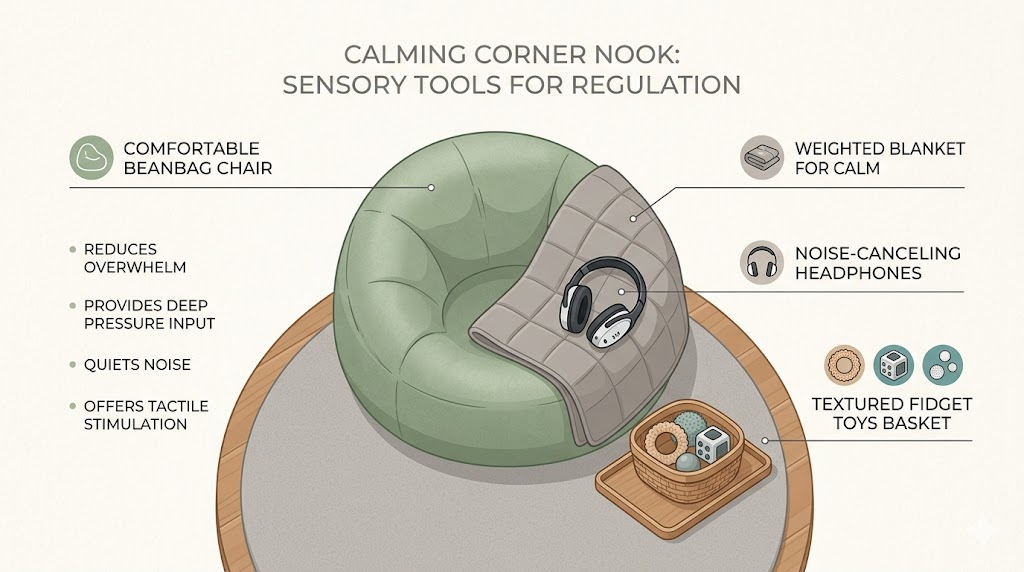
Neurodivergent children often experience sensory input—light, sound, texture, smell—more intensely than their peers. This is not a flaw; it is the starting point for every intervention we design.
A 2025 systematic review in Frontiers in Pediatrics examining sensory-based interventions for children and youth confirmed that approaches like deep pressure input and caregiver training on sensory strategies carry strong evidence for improving functional outcomes and daily participation. Importantly, the review found that targeting multiple sensory systems produces better results than targeting just one—which is why our sensory spaces are built around each child’s unique profile, not a one-size-fits-all checklist.
A sensory-safe space is not a reward and it is not a consequence. It is a regulated environment your child can access before they reach their threshold—not after. The goal is prevention, not management.
For more specific ideas you can implement at home right now, see our companion resource on AutPlay® sensory strategies for the home environment.
How to set it up:
- Location: A corner of a bedroom, a spot behind the couch, or a closet with the door left open.
- Consistency: Predictability is regulating. It should look and feel the same each time.
- Child Input: Let your child choose what goes in it. Their choices are data.
- The Golden Rule: No strings attached. This is not a “time-out” space; it is a place where nothing is required of them.
What to include: Heavy blankets or a weighted lap pad, dim or adjustable lighting, noise-canceling headphones or soft earplugs, a few familiar comfort objects, and something with repetitive tactile input—putty, a fidget, smooth stones, or textured fabric. Keep it simple and consistent. The point is predictability, not novelty.
Strategy 2: Ten Minutes on the Floor (Co-Regulation)
Your nervous system matters to your child’s nervous system. When you are regulated and present, your child’s system notices.
Research in Social Development by Morris and colleagues established the foundational model for how the family context shapes a child’s capacity for emotional regulation—through modeling, direct emotion coaching, and the overall emotional climate parents create. Co-regulation is not a technique; it is the mechanism through which all of those channels operate simultaneously.
The practical implication is straightforward: you cannot regulate a dysregulated child from a dysregulated state of your own. This is not a criticism—it is a design feature of the nervous system. It means that the most powerful thing you can do before a ten-minute floor session is take thirty seconds to regulate yourself first. Slow your breathing. Drop your shoulders. Let your face soften. Then get on the floor.
The protocol:
- Get on the floor. If they are there, you are there.
- Follow their lead. If they are sorting, you sort. If they are lining up toys, you don’t rearrange.
- Say what you see. Use simple, warm observations: “You’re putting the blue ones together.”
- No redirection. Don’t turn it into a learning moment.
- No performance. You don’t need to be animated or enthusiastic. Calm presence is the intervention.
Ten minutes feels short. It is short. But done consistently and without agenda, it sends a signal that accumulates over time—you are safe, I am here, and you do not have to earn my attention.
Need help understanding your child’s specific regulation needs? Let’s connect.
Strategy 3: Get Ahead of Transitions
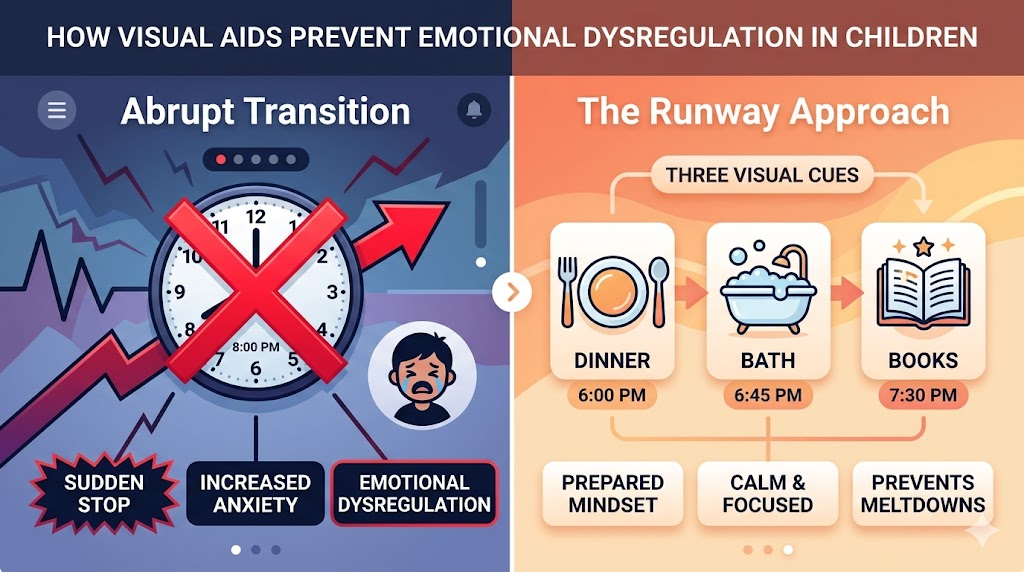
For many neurodivergent children, it isn’t the activity that causes the meltdown—it’s being pulled out of it without warning. The shift itself is costly, and it lands without preparation.
This is because many neurodivergent brains have difficulty with task-switching. What looks like a meltdown about leaving the park is often a nervous system that was not given enough runway to shift out of one state and into another. The tantrum is not about the park. It is about abrupt demand on a system that needed more time.
Use these tools this week:
- Layered Time Warnings: Give a five-minute heads-up, then two, then one. You’re not negotiating; you’re giving the nervous system a runway. Keep your voice neutral and your tone matter-of-fact.
- Visual Sequences: Use three index cards on the fridge (e.g., Dinner → Bath → Books). Uncertainty is a source of stress; visual sequences remove that uncertainty by making the next thing visible before it arrives.
- Transition Objects: Let your child carry something from one activity to the next. A small toy from the park to the car, for example, creates a physical bridge between states and reduces the felt abruptness of a transition.
Strategy 4: The Follow Me Approach (FMA)
The AutPlay® Follow Me Approach is a parent-training component built directly into the AutPlay® Therapy model. It teaches parents how to facilitate child-led play sessions at home in a way that builds the parent-child relationship and works toward therapy goals in a natural, connecting environment. Clinical programs built around this principle—where the child leads and the parent follows—are shown to promote secure attachment and reduce problem behaviors.
Your child picks the activity, and you follow their lead—completely.
- Be actually present. Not in the room while checking your email. There.
- Stop before it gets hard. End on a good note, even if that means cutting the session short after five minutes.
- Resist the urge to teach. The FMA is not a learning exercise. The moment you introduce a correction, a question, or a redirection, you shift the power dynamic and the therapeutic effect dissolves.
- Notice what they choose. The themes of a child’s play are rarely random. A child who always plays out scenes of power and control may be communicating something about how powerless they feel. You don’t need to analyze it out loud—just witness it.
The Neurobiology of Co-Regulation: Why Your Presence Is the Intervention
It helps to understand what is actually happening in your child’s brain when you sit on the floor with them, calm and present.
The nervous system’s threat-detection center—the amygdala—is highly sensitive in many neurodivergent children. It fires faster, stays activated longer, and is more easily triggered by sensory input, uncertainty, or social demands. When a child is dysregulated, the amygdala is running the show. The prefrontal cortex—the part responsible for reasoning, problem-solving, and impulse control—goes offline.
You cannot reason, redirect, or consequence a child out of an amygdala state. What you can do is offer a regulated nervous system for theirs to synchronize with. This is called neuroception—the body’s unconscious detection of safety—and it happens below the level of conscious thought. A calm voice, a soft face, a slow breath, a body at rest on the floor next to them: these are all signals the nervous system reads as safe.
Over repeated experiences of that safety—not one afternoon, but weeks of ten-minute floor sessions and predictable sensory spaces—the nervous system begins to update its baseline. The window of tolerance widens. The threshold for dysregulation rises. That is not a metaphor. That is neuroplasticity, and it is built through relationship.
Troubleshooting: When Play Gets Hard
Use this guide to adjust your approach in real-time when the nervous system becomes overwhelmed.
| Behavior | Potential Meaning | The “Co-Regulation” Pivot |
| Throwing/Hitting | Overwhelmed sensory system. | Decrease engagement. Offer a quiet, heavy-work alternative. |
| Shutting Down | Disconnection or “freeze” state. | Soften your voice. Use parallel play rather than direct engagement. |
| Demanding/Controlling | Anxiety or need for predictability. | Lean into their “rules.” Validate the need to control the environment. |
| Seeking Conflict | Need for connection/attention. | Increase “warm” observations. “You are really working hard on that.” |
| Refusing to Play | Exhaustion or low capacity. | Drop all agenda. Sit nearby without expectation. Offer presence, not prompts. |
| Repetitive/Scripted Play | Regulation through familiarity. | Join the script. Don’t redirect. Repetition is the point. |
When you find yourself unsure which pivot to use, default to less. Less noise, less talking, less proximity, less expectation. A dysregulated nervous system needs input reduced, not increased.
If you are ready to see how AutPlay® can support your family, click here to request an appointment.
Why This Work Matters: The Clinical Perspective
In my clinical work, I often see parents who feel like they are “failing” because they can’t force a regulation moment. I want to be very clear: regulation is not something you force; it is something you provide an environment for.
When you spend ten minutes on the floor, you aren’t just “playing.” You are communicating to your child’s brain that the world is a safe place to be. You are showing them that they do not need to be in a constant state of hyper-vigilance. This is the foundation upon which all other therapeutic gains are built.
Many parents ask if this is “too much” to add to their already busy lives. My answer is always the same: it isn’t adding more to your day, it’s changing the quality of the time you are already spending. It’s the difference between being present in the room and being present with the person.
There is also something I want to say to the parent who is reading this and feeling overwhelmed rather than inspired. That is a completely reasonable response to a hard job. Parenting a neurodivergent child in a world that doesn’t accommodate them well is genuinely exhausting. The strategies in this article are not one more thing you are failing to do. They are a reframe of what you are already doing—so that the small moments you are already having with your child can carry more weight.
Frequently Asked Questions
Is AutPlay® therapy covered by insurance?
Coverage varies depending on your plan and provider. Many families use out-of-network benefits, HSA/FSA funds, or work with our intake team to explore options. Contact us directly to talk through what may be available to you.
How is AutPlay® different from ABA therapy?
Applied Behavior Analysis (ABA) and AutPlay® come from fundamentally different frameworks. ABA is a behavioral approach focused on modifying observable behaviors, often through reinforcement systems. AutPlay® is a neurodiversity-affirming play therapy framework that does not seek to eliminate or “correct” neurodivergent traits. Instead, it works with a child’s natural processing style to build self-regulation, connection, and advocacy—without conditioning the child to mask or suppress who they are.
What age range does AutPlay® work for?
The AutPlay® framework is designed for neurodivergent children and adolescents ages 3–18. The specific interventions and structure vary by developmental level, but the core principles—child-led play, parent involvement, neurodiversity-affirming goals—apply across the range.
How long does it take to see results from these home strategies?
Every child is different, but most families begin to notice small shifts within two to four weeks of consistent practice—particularly around the sensory-safe space and the ten-minute floor sessions. “Results” in this context usually look like a slight increase in the child’s window of tolerance before dysregulation, small bids for connection during floor time, or reduced intensity of transition meltdowns. These are nervous system changes, and they build gradually through repeated experience.
Do I need a therapist to use these strategies at home?
No. The strategies in this article are designed to be parent-accessible without clinical training. That said, working with an AutPlay®-certified therapist gives families a level of personalization—tailored to your child’s specific profile, goals, and co-occurring needs—that a general guide cannot replicate. If your child’s behaviors are significantly impacting daily functioning or your family’s wellbeing, a clinical partnership is worth exploring.
My child refuses all play with me. Where do I start?
Start with presence without expectation. Sit near them while they do what they already do. Don’t initiate, don’t perform, don’t prompt. Just be a regulated adult body in the same space. Some children—particularly those who have experienced repeated mismatches between their needs and adult responses—need to learn that your presence is safe before they can invite you in. That phase can feel thankless. It isn’t. It is the foundation.
Frequently Asked Questions (FAQ)
1. What is the goal of AutPlay® Therapy? AutPlay® Therapy is a neurodiversity-affirming framework designed to help neurodivergent children (ages 3–18) improve self-regulation, communication, and emotional connection. Rather than trying to “fix” or suppress neurodivergent traits, it works with the child’s natural way of processing the world to build resilience and self-advocacy.
2. Can parents really act as “co-therapists” at home? Yes. In the AutPlay® model, parents are essential partners rather than observers. By learning specific, agenda-free play strategies—like the Follow Me Approach—parents can create a consistent, safe environment that reinforces the therapeutic work done in clinical sessions.
3. Why is “regulation before learning” so important? For many neurodivergent children, the nervous system’s “threat-detection” center (the amygdala) is highly sensitive. If a child is dysregulated, the reasoning part of the brain is essentially “offline.” We cannot teach or expect compliance until the nervous system feels safe. Co-regulation—offering your own calm, regulated state—is the first step to helping them process and grow.
4. What exactly is a “sensory-safe space,” and is it a punishment? A sensory-safe space is a consistent, predictable environment (like a quiet corner with heavy blankets, low lighting, and fidgets) designed for prevention. It is not a “time-out” or a consequence; it is a regulated space the child can choose to visit before they reach their threshold, helping them manage sensory input proactively.
5. How can I stop my child from having meltdowns during transitions? Meltdowns during transitions are often caused by abrupt changes that the nervous system wasn’t prepared for. To help, give your child “runway.” Use layered time warnings (e.g., 5, 2, and 1 minute) and visual sequences (like index cards showing what’s next) to remove the stress of uncertainty and provide a bridge between activities.
6. What if my child refuses to play with me? If your child refuses to engage, start with “presence without expectation.” Sit near them while they do what they already enjoy. Do not prompt, redirect, or ask questions. Simply being a regulated, calm presence nearby sends the message that you are safe to be around, which builds the trust necessary to eventually invite you into their play.
About the Reviewer
Kari Harman, MA, LPC, PLPC is a Licensed Professional Counselor and AutPlay® Certified therapist at The Wellness Counseling Center, LLC. She is also a Registered Play Therapist (RPT) in Training, specializing in neurodiversity-affirming care and trauma-informed support for families.
My philosophy is simple: My success is measured by providing you with the tools to function independently until you no longer feel the need for clinical intervention. Learn more about my approach here.
Medical Disclaimer
This article is for informational and educational purposes only and does not constitute professional medical advice, diagnosis, or treatment. Always seek the advice of your physician, licensed therapist, or other qualified health provider with any questions you may have regarding a medical or mental health condition. Never disregard professional medical advice or delay in seeking it because of something you have read here.
Crisis Support Resources
If you or your child are experiencing a mental health emergency, please seek immediate help:
- Emergency: Call or text 911 (or go to your nearest emergency room).
- Suicide & Crisis Lifeline: Call or text 988.
- Crisis Text Line: Text HOME to 741741.