
Maybe you’ve spent years being told you’re too scattered, too reactive, too hard to reach. Maybe you got an ADHD diagnosis that explained some things but not everything. Or maybe you’ve done enough reading to wonder whether what you’re carrying is trauma, ADHD, or some complicated version of both.
That question deserves a real answer.
ADHD and trauma are two distinct things, but they intersect in ways that matter — for how they’re identified, how they’re treated, and most importantly, how you feel living inside them. This article won’t hand you a checklist or a clean diagnosis. What it will do is give you a clearer picture of how these two things relate, why they’re so easy to confuse, and what effective help can look like when both are part of the story.
This article is for informational purposes only and is not a substitute for professional evaluation, diagnosis, or treatment. If you’re concerned about ADHD, trauma, or both, a qualified mental health professional can help you understand your specific situation.
When ADHD and Trauma Look the Same
ADHD and trauma — particularly trauma that develops into PTSD or complex PTSD — can look nearly identical from the outside. And sometimes from the inside, too.
Both can make it hard to sustain attention, stay present in a conversation, finish a task, or hold onto a thought long enough to act on it. Both can produce emotional reactivity that feels disproportionate to the moment: the sudden flood of frustration, the shutdown when things get hard, the way a small thing can knock the whole day sideways.
Restlessness. Impulsivity. Trouble sleeping. A persistent low-grade sense that something is wrong, that you’re always behind, that you’re failing at things other people seem to manage without effort. Shame that travels with you into rooms before you’ve said a word.
These experiences live in both ADHD and trauma. They’re not the same thing, but they produce symptoms that overlap significantly, and for clinicians, that overlap is one of the harder challenges in assessment. A 2025 systematic review published in Systematic Reviews found that ADHD was present in roughly 28% of people diagnosed with PTSD, and PTSD in approximately 36% of people diagnosed with ADHD — a rate of co-occurrence that shows just how often these two conditions travel together.
When the picture is misread — when trauma gets treated as ADHD, or when ADHD goes unrecognized because it’s assumed to be “just” the trauma — people spend years in treatment that only partially addresses what’s actually driving their experience. That has real costs. Understanding why these two things look so similar is the first step toward getting the right kind of help.
How ADHD and Trauma Influence Each Other
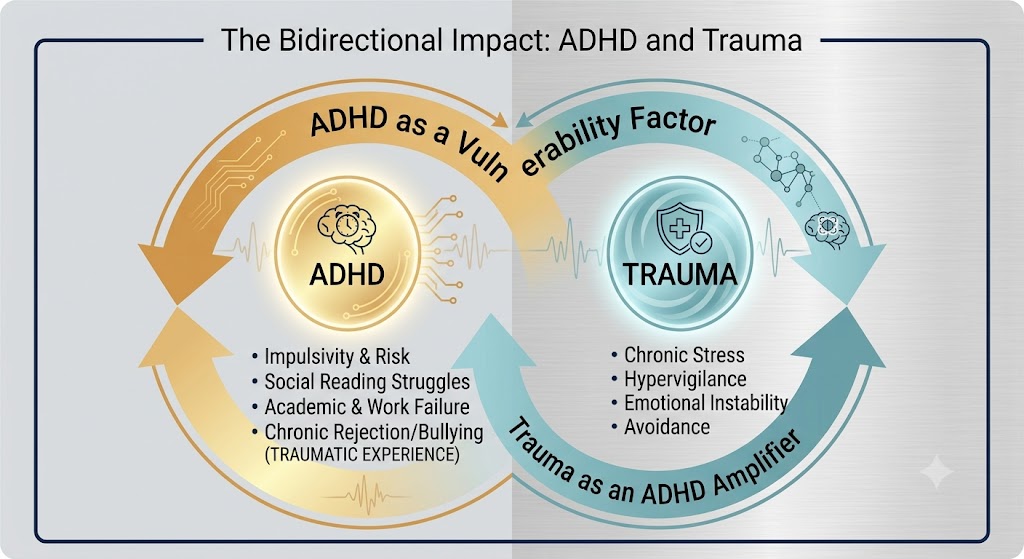
These aren’t two parallel tracks that happen to share some scenery. ADHD and trauma have a bidirectional relationship; each can shape the other in meaningful ways. Three threads are worth understanding.
ADHD as a Vulnerability Factor
People with ADHD are more likely to experience traumatic events across their lifetime. Not because of any flaw in character — because of how ADHD affects daily life. Impulsivity can lead to situations that carry real risk. Difficulty reading social cues can leave someone more exposed in relationships where harm is possible. Struggles in school and at work produce chronic experiences of failure, criticism, and rejection that, accumulated over years, are genuinely traumatic in the way they teach a person what to expect from the world.
Bullying is one concrete example. Research consistently shows that children with ADHD experience victimization at significantly higher rates than their neurotypical peers. A 2024 study in the Journal of Autism and Developmental Disorders using five years of nationally representative U.S. data found children with ADHD face disproportionately high rates of bullying, with some studies placing victimization above 35% when tracking youth across multiple school years. Then there’s the quieter kind of damage: the particular grief of knowing you’re trying your hardest and still not meeting the standard. For someone with ADHD, the path toward trauma is often shorter than for someone without it. Not because they’re weaker, but because the terrain is harder.
Trauma as an ADHD Amplifier
For people who already have ADHD, trauma doesn’t add a separate layer so much as it turns up the volume on what’s already there. Hypervigilance — that constant, exhausting scan for what might go wrong — layered on top of already-strained attention makes sustained focus feel nearly impossible. Emotional dysregulation that’s already a feature of ADHD becomes more intense, more unpredictable, slower to recover from.
Research bears this out. According to Neurodivergent Insights’ clinical review of the ADHD-PTSD literature, the co-occurrence of ADHD and PTSD is associated with more severe symptom burden than either condition alone, meaning people carrying both tend to experience significantly more daily difficulty than those managing one. Trauma also generates avoidance: pulling back from situations, relationships, or tasks that feel unsafe or overwhelming. For someone with ADHD, avoidance compounds an already difficult relationship with the things they need to get done. The two conditions don’t simply coexist. They compound each other, and without treatment that accounts for both, progress on one front is often stalled by the other.
When Trauma Mimics ADHD
This is the thread that gets the least attention, and probably the most important one.
For some people — particularly those who experienced chronic, early, or relational trauma — the brain and body adapt in ways that look clinically identical to ADHD. Difficulty concentrating, emotional dysregulation, impulsivity, restlessness: these aren’t only features of a neurodevelopmental condition. They’re also features of a system that learned, in the presence of ongoing threat or instability, to stay alert and ready.
When trauma begins early enough — in infancy, toddlerhood, or the early school years — it can shape development in ways that are nearly indistinguishable from ADHD on a symptom checklist. A clinical overview from ADDitude Magazine and the Child Mind Institute notes that standard ADHD screening tools often omit the social and environmental context that would help clinicians tell a trauma response apart from a neurodevelopmental condition. This is why “is my ADHD a trauma response?” isn’t a strange question. For some people, it’s exactly the right one.
The honest answer: sometimes what presents as ADHD is the long-term mark of chronic stress. Sometimes ADHD is a neurodevelopmental reality that exists entirely independently of any trauma history. And sometimes — often — both things are true at once. There’s no shortcut through this. A thorough clinical assessment that takes the full history seriously is the only way to understand which picture you’re actually looking at.
What This Looks Like in Adults
Most of the research and public conversation around ADHD and trauma centers on children. But adults carry this complexity too, often for decades before anyone names it clearly.
ADHD has historically been underdiagnosed in adults, particularly women, who more often present with inattentive rather than hyperactive symptoms. A 2024 survey by The Ohio State University Wexner Medical Center found that one in four American adults suspects they may have undiagnosed ADHD, yet only 13% had spoken to a doctor about it. Many of those adults spent childhood being called lazy, dramatic, oversensitive, or difficult. They learned to cope by working twice as hard, or by shrinking, or by building elaborate systems to compensate for what wasn’t working — systems that took enormous energy to maintain and sometimes fell apart under ordinary pressure.
For adults, the overlap between ADHD and trauma tends to show up in recognizable patterns. Chronic underachievement despite real intelligence and effort. Relational instability — connections that start well and fracture in ways that feel confusing or unearned. Difficulty in professional environments where sustained attention and emotional steadiness are just assumed. A persistent sense of shame that doesn’t respond to logic or evidence. If you want more on how emotional regulation difficulties show up day to day, our guide to the Zones of Regulation is a good place to start.
Adults with unaddressed ADHD often carry secondary trauma too. Years of failure, criticism, misunderstanding, and social rupture accumulate. By the time someone walks into a therapist’s office in their thirties or forties, they may be carrying both a neurodevelopmental condition and a significant trauma history, each shaped by the other over a long time.
It is not too late. Assessment and treatment are valuable at any age, and many adults find that finally understanding this picture — really understanding it — is itself a meaningful form of relief.
Getting the Right Help When Both Are Present
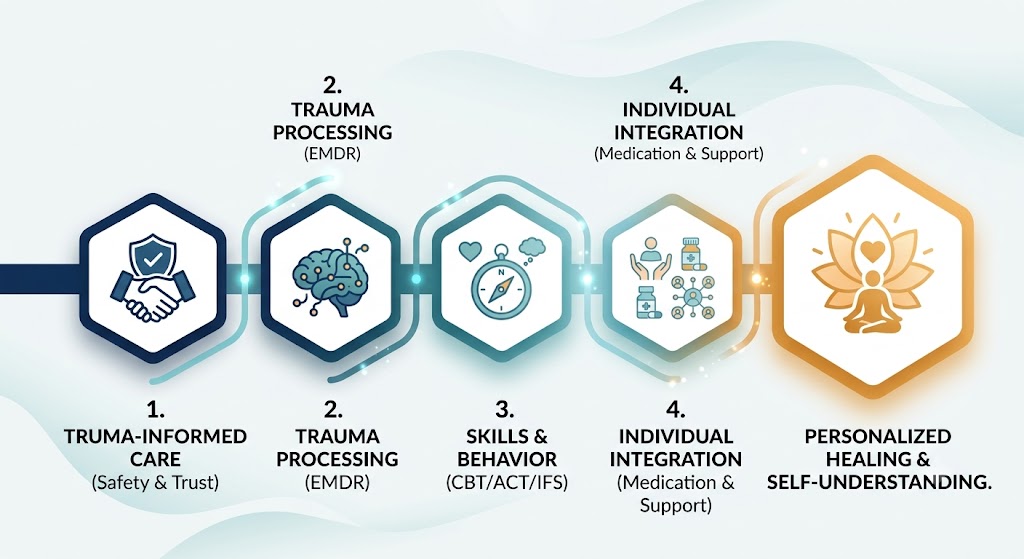
When ADHD and trauma are both part of the picture, treatment needs to hold both. Treating only one — addressing ADHD symptoms while leaving trauma unexamined, or processing trauma while underlying ADHD goes unrecognized — tends to produce partial progress that’s hard to sustain.
The foundation of effective care here is trauma-informed practice. Every aspect of treatment is shaped by an understanding of how trauma affects people: prioritizing safety, building trust at a pace the client can tolerate, and being careful not to recreate experiences of powerlessness or overwhelm in the therapy room itself. Trauma-informed care isn’t a single technique. It’s an orientation that changes how everything else is done. Our trauma therapy page has more on what that looks like in practice.
Within that foundation, several approaches tend to be particularly well-suited to this overlap:
EMDR (Eye Movement Desensitization and Reprocessing) is among the most extensively studied approaches to trauma processing. Multiple meta-analyses of randomized controlled trials confirm that EMDR meaningfully reduces PTSD symptoms, depression, and anxiety in people with trauma histories. A 2024 meta-analysis published across 15 randomized controlled trials found it comparable in effectiveness to other leading treatments like Cognitive Processing Therapy and Prolonged Exposure. For people whose ADHD symptoms are being significantly amplified by unprocessed trauma, EMDR therapy can reduce the intensity of those trauma responses in a way that makes the underlying ADHD easier to address. Our clinicians are trained in EMDR and offer it as part of trauma-focused care at The Wellness Counseling Center.
CBT and ACT — Cognitive Behavioral Therapy and Acceptance and Commitment Therapy — offer practical, skills-based tools for building executive function, managing distress, and developing new responses to old patterns. These work well alongside trauma processing, not instead of it.
Internal Family Systems (IFS) is particularly useful for the shame and self-blame that travel alongside this combination. Many people with ADHD and trauma histories carry harsh inner critics — parts of themselves that internalized years of external criticism. IFS therapy works with those parts rather than trying to override them.
For some people, medication is also part of the picture. Whether that’s right for you is a conversation to have with a prescriber who understands your full history — both the ADHD presentation and the trauma context. Our Getting Started page explains what a first step at TWCC actually looks like.
Ready to Talk? We’re Here.
At The Wellness Counseling Center, we work with people dealing with ADHD, trauma, and the complicated space where they meet. Our clinicians are trauma-informed, experienced with complexity, and interested in the full picture — not just the presenting complaint.
Two good places to start, depending on where you are:
If trauma is part of your story and you’re ready to start working through it, our trauma therapy team offers trauma-focused care including EMDR, IFS, and other evidence-based approaches, in person and via telehealth.
If you’re not sure where to start — if the picture still feels murky and you just need a first conversation — individual therapy is the right door. We’ll figure out the rest from there.
We see clients in Overland Park, KS, Greenwood, MO, and Harrisonville, MO, and offer telehealth across Missouri, Kansas, and several additional states.
Call us at 816.477.3772 or visit our Getting Started page. Our care team will be in touch.
Frequently Asked Questions
Can trauma cause ADHD?
Trauma doesn’t directly cause ADHD, which is a neurodevelopmental condition. But early or chronic trauma — particularly in childhood — can produce symptoms that closely resemble it. In some cases, what looks like ADHD is the brain’s learned adaptation to prolonged stress or instability. A thorough clinical evaluation is the most reliable way to understand which is true for you, or whether both are present.
Can you have both ADHD and PTSD at the same time?
Yes. Research shows these two conditions co-occur at meaningful rates, with ADHD found in a significant portion of people diagnosed with PTSD and vice versa. Each tends to make the other harder to manage, which is why effective treatment takes both seriously rather than treating one as the main problem and the other as secondary.
How do therapists tell ADHD and trauma apart?
There’s no single test. Clinicians look at the full history: when symptoms first appeared, whether there’s a clear before-and-after tied to a specific event or period, how symptoms show up across different settings and relationships, and what the developmental timeline looked like. It’s a picture built over time, not a quick checklist. This is one reason a thorough intake matters.
Is ADHD a trauma response?
Sometimes. For some people — particularly those who experienced early or chronic relational trauma — what looks like ADHD is the long-term mark of a system that adapted to ongoing stress. For others, ADHD is a neurodevelopmental reality that exists regardless of trauma history. For many, both things are true at once. This is exactly why a careful, individualized assessment matters.
What does trauma-informed ADHD treatment look like?
It means the therapeutic relationship and every treatment decision are shaped by an understanding of how trauma affects people: prioritizing safety, building trust carefully, pacing the work to what the person can actually tolerate. Specific approaches like EMDR, IFS, CBT, and ACT can all be delivered within a trauma-informed framework.
Shannon Hiser, LPC, LCPC, RPT-S, NCC is the founder of The Wellness Counseling Center, LLC, a group practice with locations in Overland Park, KS, Greenwood, MO, and Harrisonville, MO. Shannon specializes in trauma-informed care, play therapy, and the integration of clinical and whole-person approaches to healing.